


gVaults are live on Monad.
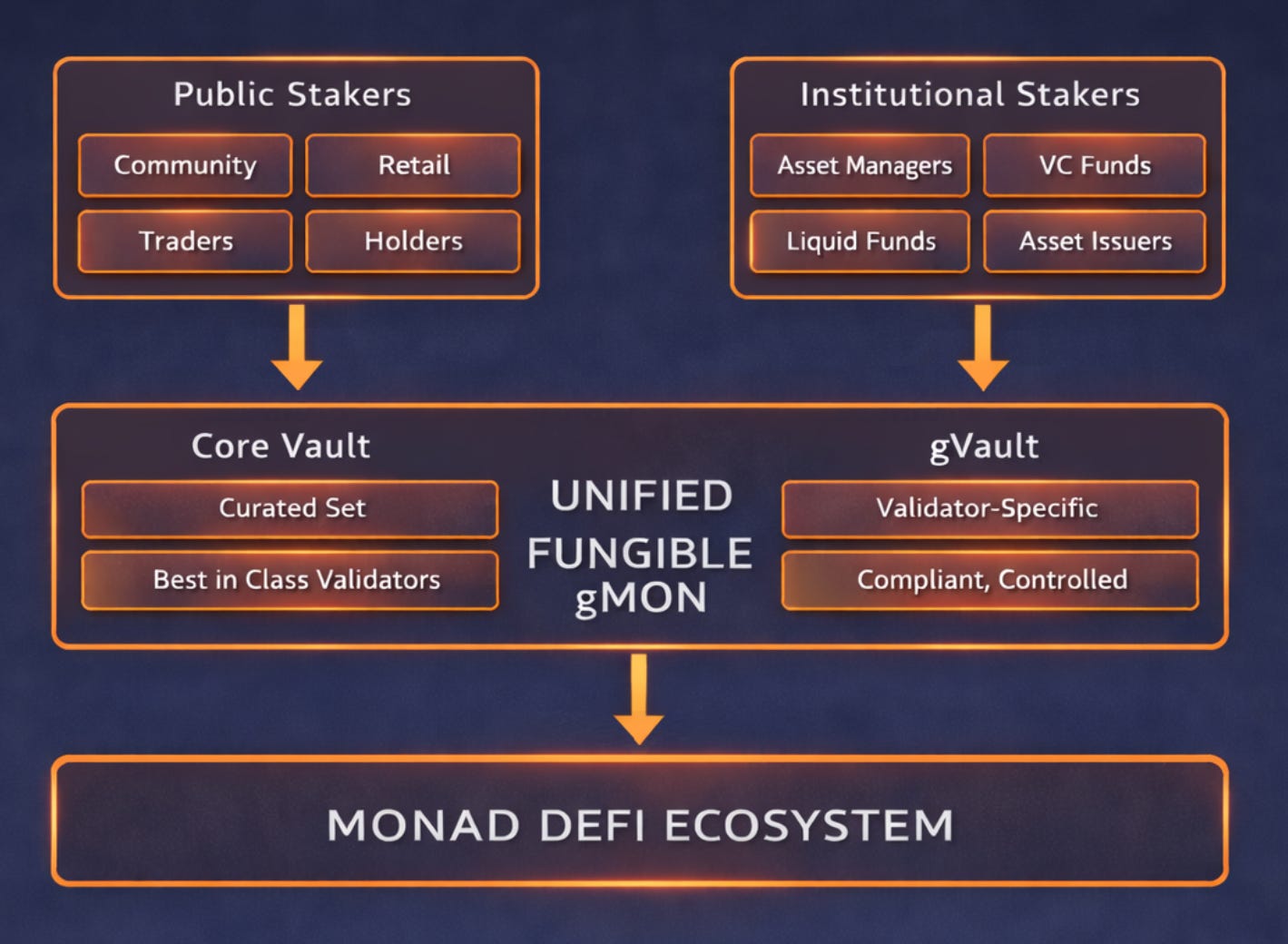
gVaults are the first validator-specific liquid staking outside of Lido V3, designed from first principles around how the Monad ecosystem is expected to evolve. gVaults introduce validator-specific delegation without fragmenting liquidity. Users can stake directly to a chosen validator while receiving the same fungible $gMON token used across Magma’s integrations.
Validator-level staking without breaking the liquidity layer
Magma is enabling the first-ever institutional-grade staking infrastructure on Monad. Validators who join now are establishing a footprint before the network scales.
Most liquid staking systems aggregate deposits into a shared pool where attribution to individual validators fades into the background. That model is operationally clean, but it also removes visibility and flexibility for both stakers and operators.
With gVaults, deposits made through a validator vault are delegated directly to that validator while still minting the same $gMON token as the rest of the protocol. In practice this means a staker can know where their stake sits without stepping outside the broader liquidity environment.
Institutional access without basket ambiguity
In our many conversations with validators and institutional allocators, we noticed a recurring theme that kept on surfacing: pooled delegation can complicate underwriting decisions when counterparty visibility and infrastructure control matter. In traditional pooled staking models, capital is spread across a basket of validators, which then makes it harder for allocators to assess where operational risk actually sits.
For institutions that perform internal due diligence on infrastructure providers, that abstraction becomes problematic. Investment committees need to understand exactly which validator is responsible for securing the stake, what their operational track record looks like, and how risk is distributed across counterparties to be able to make a decision on how to proceed with capital allocation.
gVaults’ structure maps more naturally to those requirements as it allows institutions to delegate to a validator they previously vetted while receiving $gMON and maintaining full liquidity within the broader ecosystem. As a result, validator-specific exposure and liquid staking, can coexist within the same system.
This structure also improves operational clarity. As risk attribution becomes easier to model, reporting becomes simpler, and allocations can be aligned more closely with internal mandates or counterparty limits. At the same time, capital remains inside Magma’s liquidity layer, allowing institutions to retain the flexibility that liquid staking provides.
Practically this change is relatively small but for allocators who treat validator infrastructure as a real counterparty risk, it removes a surprising amount of ambiguity.
Designed for Monad
Staking vault models introduce a set of constraints that become obvious once you model them seriously. Concentrated exposure to a single validator increases slashing impact. Multiple liquidity flows can diverge during stress events and correlated behavior can emerge across vaults when market conditions tighten. Our developers have identified that these are not edge cases but design realities and so our approach was designed specifically to mitigate these risks.
Validator participation in gVaults is gated through a whitelisting framework based on performance history and operational standards. Relative deposit caps, based on relative stake to total protocol TVL, limit concentration while leaving room for growth where demand is demonstrated. Deposit caps and validator screening are designed to limit the impact of any single validator while preserving token fungibility and system stability.
If a validator underperforms or falls below thresholds, they can be removed from the set and whilst that mechanism is not particularly novel, it is an important presence in our current approach.
Capital efficiency without additional overhead
Traditional vault implementations address risk through over‑collateralization, effectively asking participants to lock more capital than is actively staked as a protective buffer. The trade‑off here is additional safety margin at the cost of efficiency.
gVaults instead rely on validator screening, exposure limits, and system safeguards to manage similar constraints without introducing additional idle capital requirements.
Ease of use for max efficiency
For validators, the experience is intentionally light-touch. Each operator receives a customized deposit portal inside Magma’s interface that can be shared directly with their network. Deposits made through that portal are delegated fully to the associated validator while still minting $gMON at the same rate as deposits made into the Core Vault, ensuring parity across the system. There is no contract deployment, no additional integration work, and no parallel infrastructure stack to maintain — the vault becomes part of the system rather than something separate.
Participation in gVaults sits within a structured validator framework with strict participation parameters and operational standards that are under continuous review by our team.
Redeemability as a baseline expectation
Maintaining predictable redemption pathways remains a core constraint for any liquid staking design. Under extreme liquidity fragmentation, the protocol may perform controlled rebalancing between gVaults and the Core Vault to preserve fungibility and orderly redemption. This mechanism is designed as an infrequent safeguard rather than a routine operation.
Participants retain their $gMON position, with system adjustments occurring only where necessary to maintain protocol‑level redeemability.
Security review and simplification
When we announced that we were building gVaults, the architecture had already undergone independent security reviews by Cantina, Halborn, Zellic, and Zenith, as part of our complete project audit. In the months since we have submitted all our gVaults contract for a second round of reviews, complementing internal simplification work that preceded final audit cycles.
That simplification step was arguably as important as the audits themselves; removing complexity often reduces risk more effectively than layering additional mechanisms. As security is one of the values that we hold dear the most, this was a non-negotiable to satisfy our high level of standards.
Positioning within Monad’s trajectory
As the Monad ecosystem matures, validator differentiation, institutional participation, and liquidity composability are likely to become increasingly intertwined. Through that lens, gVaults are best understood as just one component of a broader staking infrastructure direction, instead of a just singular solution.
Validators now have a path to potentially 10x revenue on delegated stake without compromising liquidity. By enabling validator-level staking without sacrificing liquidity cohesion, gVaults aim to support that direction early rather than retroactively adapting to it.
Our first validator cohort will consist of DTEAM, Pathrock Network, ITRocket, Forest Staking, Provalidator, Rhinostake, Polkachu, Moonlet, Node Monster, Stakely, NodeInfra, Crouton, Stakecito, Enigma, Stakeme, Cosmos Spaces, Spectrum Staking, Flipside, Nodes Guru, Lavender Five, Staking4All, Coinage X DAIC, Chainlayer, Blockscape, SimplyStaking, DSRV, Chorus One, Everstake, P2P.org, P-OPS, Go2Pro, LakeStake, Stakeus, Cassini Living, Stake Shark, Lux8, Stakin, Allnodes, Stakecraft. This group reflects the performance standards and operational rigor required to participate in gVaults.
With gVaults now live, staking vaults will become part of the network’s day-to-day infrastructure: imperfect, evolving, and now observable in practice.